Is salvation a ‘wide open space’?
 I have often heard information technology said that when God delivers us, he leads usa from a sense of being trapped, hemmed in and confined to a sense of being in a 'wide open space.' I think I have probably said this myself in a talk or sermon on more than one occasion. I remember, many years ago, reading about it in relation to the story of Jacob and his meeting with Esau in Genesis 33; Jacob, who has relied on his wits all his life to get his ain way—with other people and with God—finds himself at his wit's end as he finally meets Esau again. But instead of judgement, he finds graciousness, and the graciousness of Esau he takes to be the graciousness of God, and he moves from the sense of being hemmed in by fear and dread to the open space of grace and peace.
This notion, of being in a tight spot or hemmed in and then experiencing God's deliverance every bit a broad space, is evident at several points in the psalms. A good example is Ps eighteen:
3 I chosen to the Lord, who is worthy of praise,
and I accept been saved from my enemies.
4 The cords of death entangled me;
the torrents of destruction overwhelmed me.
5 The cords of the grave coiled around me;
the snares of expiry confronted me.
17 He rescued me from my powerful enemy,
from my foes, who were too strong for me.
19 He brought me out into a spacious place;
he rescued me because he delighted in me.
It is quite striking how many of the psalms are written around the theme of conflict with the writer's enemies, how oppressed he has been, and how (usually) God has delivered him, either by an act of rescue or an act of judgement on the writer's enemies.
Some other explicit instance of this metaphor comes in Ps 118.five:
When difficult pressed, I cried to the Lord;
he brought me into a spacious place.
(Ps 118 is particularly important in the NT, vv 25 and 26 forming the background to the accounts of Palm Sunday, and v 22 being understood by Jesus and Peter equally anticipation of Jesus' rejection past the Jewish leaders.)
It is worth noting that salvation in these contexts is very tangible, and not very far removed from common uses of the term in everyday speech communication today—it is about deliverance from actual enemies who oppress us. Information technology is used in this sense in Zechariah'south prophetic song of praise we telephone call the Benedictus in Luke 1.68–79:
69 He has raised upwardly a horn of salvation [or 'mighty saviour'] for us
in the house of his retainer David…
71 conservancy from our enemies
and from the hand of all who hate u.s.a.— …
74 to rescue us from the manus of our enemies,
and to enable u.s.a. to serve him without fearfulness
75 in holiness and righteousness before him all our days.
It only becomes a 'religious' term one time we recognise that our truthful enemies are not the people that oppose us, but the threat of sin (ours too as theirs) and decease (i Cor xv.26). Thus the affections commands Joseph to 'give him the name Jesus [Yeshua, 'God saves'] because he will save his people from their sins.'
This idea of salvation as a broad open up space is appealing not simply because of these examples in the OT, merely because (like so many of the Bible's metaphors) is engages us psychologically with such power. When we experience people or things are against united states, we do have this sense of beingness strangled, or hemmed in, or in a tight space. We might even use these metaphors ourselves. And when the situation changes, nosotros feel we can breathe again, that we are no longer constrained—we are gratuitous to roam the wide open spaces of God's deliverance and grace.
The case I have used in the by comes from a journey that, at i point, I made quite frequently. On the M40, travelling from High Wycombe towards Oxford, after travelling on a plateau, you come up through a last cutting as the road bears gently to the right. The bend hides the view that opens up before you lot (I think somewhere near Princes Risborough) of a broad open patently—and it offers a very hit contrast to the narrowness of the cut every bit you emerge from it. No wonder this idea features in so many sermons.
Only nosotros need to pause a little, since I retrieve there are three issues with this metaphor which might qualify its use.
The first is with language. It is often claimed that 'The Hebrew for salvation is yasha, which means 'to bring into a wide open infinite.' (Forgive, for a moment, the motion from substantive to verb). From Hebrew lexicons it is not very obvious that this is in fact the case. Take the abridged version of Brown, Driver and Briggs (BDB), a standard lexicon:
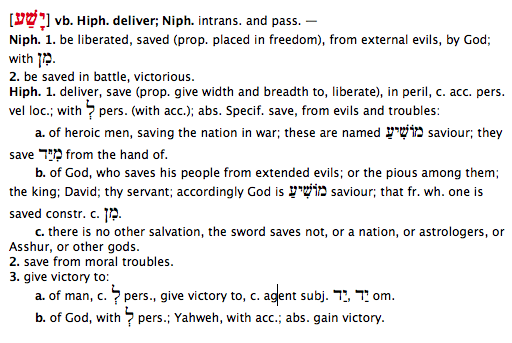
In that location are some hints that information technology used in this fashion from the additional comments:
(prop. placed in freedom) (prop. give width and latitude to, liberate),
simply I would need to see some more convincing prove before going with this as 'the' significant of the give-and-take. The straightforward sense is to exist rescued from (oppressive) enemies; this can certainly feel like we accept moved into a wide open space, but that is non the word's 'meaning'. Possibly it would be ameliorate to talk of salvation 'sometimes being equated with…' rather than 'meaning…' something.
Secondly, it has often not been the experience of Christians that God has brought them into this sense of a 'wide open infinite' fifty-fifty though they have been 'saved.' On Monday evening at New Wine, John Coles told the story of Horatio Spafford, who wrote the hymn 'It is well with my soul'.
This hymn was written subsequently traumatic events in Spafford'due south life. The first was the death of his son at the age of two and the 1871 Great Chicago Burn down, which ruined him financially (he had been a successful lawyer and had invested significantly in belongings in the expanse of Chicago that was extensively damaged by the great fire). His business organisation interests were farther striking by the economic downturn of 1873, at which time he had planned to travel to Europe with his family on theSS Ville du Havre. In a late alter of programme, he sent the family ahead while he was delayed on business concerning zoning problems following the Cracking Chicago Fire. While crossing the Atlantic, the ship sank speedily after a collision with a sea vessel, theLoch Earn, and all four of Spafford'due south daughters died. His wife Anna survived and sent him the now famous telegram, "Saved alone …". Shortly afterwards, as Spafford traveled to meet his grieving wife, he was inspired to write these words every bit his ship passed well-nigh where his daughters had died.
This is inappreciably a 'wide open space', and it is interesting that the words of the hymn avoid this kind of imagery, and instead articulate promise in eschatological terms—anticipating ' the mean solar day when my faith shall exist sight, The clouds exist rolled back as a scroll; The trump shall resound, and the Lord shall descend.'
Thirdly, I was quite interested to find this idea of 'salvation as a wide open space' in a sermon online drawing on the work of the liberal theologian Marcus Borg. Conservancy was not about waiting for some future event; it did not depend on our own lives or what we did; no, it was about enjoying the 'wide open spaces' of healing and life that God gives us at present in Jesus. There was quite a strong sense that this 'wide open infinite' is ane which is free from (perhaps petty, even 'Pharisaic') concern with regulations about holiness.
This is a rather stark contrast not just to all the linguistic communication nigh future hope in the gospels and in Paul, just also to Jesus' ain depiction of what the 'saved' life looks like:
Enter through the narrow gate. For broad is the gate and broad is the route that leads to destruction, and many enter through it. Merely small is the gate and narrow the road that leads to life, and only a few find it. (Matt 7.13–fourteen)
Echoes here of eyes of needles rather than wide open spaces. And it is fascinating to note that this is exactly the same dynamic we discover in Ps 18—if nosotros read to the cease of the psalm. David is delivered into the wide open infinite, he says, because he has been walking the narrow path of obedience to God's law. He does non find is constricting, simply the path of life and freedom. We notice similar paradoxes in Paul: he is 'constrained past the dearest of Christ' (2 Cor 5.14) and celebrates the 'freedom for which Christ has set us free' but longs nosotros should utilize that freedom to walk only where the Spirit leads us (Gal 5.ane, 16).
The moral here is that, when we utilise a metaphor from Scripture, and specially such a compelling one, we demand to attend advisedly to thewaythat these metaphor are deployed.
But it too touches on a wider problem that we have in many parts of the church of the tension between grace and obligation. There is no limit to the kind of person to whom God offers his gracious invitation. Invitation is to forget self, have up the cross and follow him. The wide space of freedom means we can choose to walk the narrow path of obedience that Jesus walked and in which we follow.
If yous enjoyed this, practice share it on social media (Facebook or Twitter) using the buttons on the left. Follow me on Twitter @psephizo. Like my folio on Facebook.
Much of my work is done on a freelance ground. If you have valued this mail, you tin make a single or repeat donation through PayPal:
Comments policy: Good comments that engage with the content of the mail service, and share in respectful argue, can add real value. Seek first to understand, then to be understood. Make the nearly charitable construal of the views of others and seek to learn from their perspectives. Don't view fence as a conflict to win; address the argument rather than tackling the person.
Source: https://www.psephizo.com/biblical-studies/is-salvation-a-wide-open-space/
0 Response to "Is salvation a ‘wide open space’?"
Post a Comment