Ice Age Concept Art Ice Age 2 Concept Art
I am looking at women with floppy breasts, massive hips and eyeless faces. Their bodies are deeply alien – disturbing in their total lack of what the modernistic world sees equally desirable. Nearby, the British Museum has installed two nudes by Matisse, in i of many attempts in this exhibition to draw parallels between the primeval art and that of our own era. But this comparison merely adds to the unease. To put it in linguistic communication no archaeologist is likely to utilize: the curves of a Matisse woman are sexy; the bulges and blanknesses of these nudes, carved from ivory in primal Europe 30,000 years ago, are not.
Then something catches my eye: a sculpture of a bison, created 21,000 years ago. It's and then real, so alive, I tin can almost hear it snort and postage stamp. Information technology has the aforementioned magical presence, the aforementioned thrilling realism, as cavern paintings I've seen, also dating back to the ice age: images of mammoths, horses, bison. So why did the same artists cull to depict humans with such bizarre abstraction? It is one of the mysteries that make this show and so eerie and thought-provoking.
Ice Age Art is subtitled Inflow of the Modern Mind. Its thesis is that 40,000 years agone, when humans migrated from Africa into a insufficiently temperate Europe, and were then caught for thousands of years amid the freezing temperatures and furry beasts of the last great freeze, something miraculous happened. Art appeared: art then sophisticated, information technology proves that the cognitive faculties we value so highly today were fully evolved tens of thousands of years ago (the works here were made between 40,000 and 10,000 years ago). Only a modernistic human mind, the argument goes, could create a masterpiece like the Zaraysk bison (it is named after the boondocks about Moscow where it was discovered). Simply this show isn't just an run into with the first modern minds. It also reveals how peculiar and mysterious those minds were. Why make fine art at all? Why shape figures to await like animals and women?
The showtime art created in Europe included portable works like the sculptures and carvings that characteristic in this show; and cave paintings, which obviously have to stay put. This gives the curators a tricky chore: how to prove the quondam and convey the latter, while avoiding a sense of archaeological dustiness. One solution is to juxtapose ancient ivory carvings with modernist works such as a Henry Moore sculpture and a Mondrian drawing. This is sadly misguided. The avant-garde work of the 20th century echoes ice-age art – non to mention African masks and Oceanian statues – because artists like Picasso chose to emulate whatever freed their minds from western realism. These pairings tell us cypher near the ice age and are a distraction.
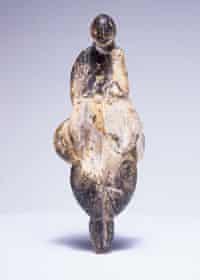
The first exhibit here is a sculpture of a woman, carved in ivory with a bulbous, abstract symmetry about 23,000 years ago. She was found in the Rideaux Cave in Lespugue, France, in the foothills of the Pyrenees. Known as the Venus of Lespugue, she fascinated Picasso; his two replicas can be seen in a photo adjacent to this exquisite carving. But what does the fact that Picasso loved this sculpture reveal about ice-age art? Most equally much as his utilise of African masks tells us about the societies that produced them. Information technology feels like crowd-pleasing: the presence of modern art reassures us we are looking at a cool and current exhibition – not just some highbrow, nerdy delve into the ancient. Sky preclude we should exist asked to think ourselves outside our own cultural bubble.
Unlike Matisse, Moore, Mondrian and Picasso, the creators of ice-age fine art belonged to a world where people hunted to stay live; they portrayed animals that are now extinct; and they lived in a world without cities, writing or agriculture. These water ice-age humans may have been like us biologically, but they had ideas we can only guess at. The women they carved in ivory, and fifty-fifty moulded from dirt in the Danube Valley, are utterly enigmatic. Could they be fertility goddesses? That question simply reflects the fact that it'southward difficult to associate them with later, erotic images of the nude. We don't even know if they were carved by men or women; no show exists. There is no reason to believe the commencement artists weren't women: these figures may exist emblems of matriarchal power.
The tiny human faces featured in this evidence include "the oldest portrait of a adult female", equally the gallery titles one picayune masterpiece made in the Czech republic 26,000 years ago. The adult female'south disfigured eye suggests this is an private portrait, drawn from life. Merely such verisimilitude appears to have been an exception: homo bodies in this show are overwhelmingly abstract, while animals are portrayed with gobsmacking accuracy – from line drawings of reindeer to lions carved on ivory. While humans have been washed better, no one – non even Leonardo – has ever surpassed these ice-age animal portraits. The first cave paintings, discovered in the late 19th century, were dismissed as forgeries: they seemed too adept to exist the work of "savages". Nowadays, dating techniques have silenced such doubts.
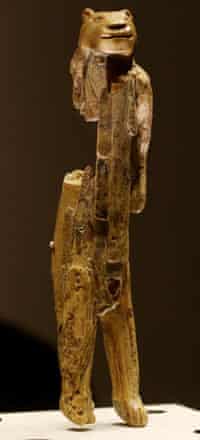
So what are we to make of the works that fuse animals and humans? The oldest object hither is the Lion Man, a carving pieced together from fragments found in Stadel Cave in the German Alps. About 40,000 years old, this man figure with a lion'southward head stands tall, reeking of dreams, terror, magical rites and myths. Information technology makes me think of those animal-headed Egyptian gods, with their air of the supernatural. Meanwhile, a clever video installation delves deep into the earth of the Lion Man. In a darkened room, images from caves at Chauvet and Pech Merle flash across stone-like surfaces, flickering every bit if in the firelight by which these paintings were get-go seen. The upshot is thrilling, a bang-up improvement on photographs: we see herds of horses, portraits of lions, as if we were in the caves themselves.
In the next room, that sense of idolatry intensifies. The carved head of a musk ox looms out of the shadows, amid rock reliefs of galloping horses; it is like an epitome of worship. What made animals the real stars of ice-historic period fine art? Information technology may be because this art reflects a long-lost system of religious belief that saw animals equally supernatural creatures, divine beings, gods. The first artists were not just portraying horses, but horse spirits. It seems highly plausible, as South African archaeologist David Lewis-Williams argues in his volume The Listen in the Cave, that these artists were shamans who worked in a trance.
It was the mammoth, the bison and the horse that captured the imaginations of these artists and inspired their greatest work. As this fascinating exhibition reveals, the modern human listen begins with the same questions about gods and monsters, the same curiosity about nature and chapters for fantasy, that accept shaped information technology ever since.
Source: https://www.theguardian.com/artanddesign/2013/feb/05/ice-age-art-jonathan-jones
0 Response to "Ice Age Concept Art Ice Age 2 Concept Art"
Post a Comment